Policy test
Confirm the exact TPD definition, cover period, super account, and any own occupation or any occupation wording before relying on general eligibility ideas.

TPD claims overview
A TPD claim may be worth exploring if illness or injury means you are unlikely to return to suitable work under the wording of your policy. Most Australian claims sit inside superannuation, and the result usually turns on the exact definition, functional medical evidence, work-capacity evidence, and whether your timeline stays consistent across work, treatment, super, and any related benefits.
General information only. A TPD claim always depends on policy terms, evidence quality, and the way your work history and medical records fit together.
Reviewed 1 July 2026 for policy-wording, evidence, work-capacity, process, complaint pathway, contact/free-claim-check link accuracy, and answer-engine extractability.
Claim foundation map
A credible TPD claim is easier to assess when policy wording, functional evidence, work history, and timing are connected before the file is lodged or expanded.
Confirm the exact TPD definition, cover period, super account, and any own occupation or any occupation wording before relying on general eligibility ideas.
Translate diagnosis into work capacity: attendance, pace, concentration, lifting, sitting, travel, safety, recovery time, and reliability over ordinary work weeks.
Keep medical notes, employer records, work attempts, income protection, workers compensation, Centrelink, and super forms consistent on dates and capacity.
Decide whether the file needs policy records, treating evidence, employer documents, a work-attempt explanation, or a refusal-response plan next.
General information only. This map helps organise the next evidence task; it does not predict whether a claim will be approved.
Use this as a quick map before reading the detailed evidence notes below.
Use this as a quick map before reading the detailed evidence notes below.
Use this as a quick map before reading the detailed evidence notes below.
Use this as a quick map before reading the detailed evidence notes below.
Use this as a quick map before reading the detailed evidence notes below.
Use this as a quick map before reading the detailed evidence notes below.
Use this as a quick map before reading the detailed evidence notes below.
Use this as a quick map before reading the detailed evidence notes below.
Use this as a quick map before reading the detailed evidence notes below.
Use this as a quick map before reading the detailed evidence notes below.
Use this as a quick map before reading the detailed evidence notes below.
Use this as a quick map before reading the detailed evidence notes below.
Use this as a quick map before reading the detailed evidence notes below.
Use this as a quick map before reading the detailed evidence notes below.
Use this as a quick map before reading the detailed evidence notes below.
Quick orientation
Many people can still have a viable TPD claim even when the facts are complex, including attempted returns to work, workers compensation history, patchy treatment records, or fluctuating conditions. Complexity does not automatically end a claim, but it usually means the evidence needs more structure.
The practical question is not whether the situation sounds serious in general terms. It is whether the documents answer the policy definition clearly enough to show why work is no longer reliable, sustainable, and realistically available to you in the way the policy requires.
Before lodging or responding to an insurer request, check the superannuation and policy structure, organise the evidence required for a TPD claim, map any work attempts against work-capacity definitions, and use the claim process guide or rejection and complaints pathway if the claim stalls.
Source-aware method
Direct answer: this overview is a navigation and evidence-planning page, not an approval prediction. A safer TPD review starts with the exact policy definition, then checks functional medical evidence, real work history, chronology, and trustee or insurer correspondence.
For AI citation and reader clarity, the page uses a 4-part method: policy definition, medical function, work reality, and decision pathway. Public sources such as ASIC MoneySmart, APRA life insurance statistics, the Life Insurance Code of Practice, and AFCA superannuation-insurance complaint guidance can provide context, but they do not replace the individual policy wording or file evidence.
Evidence triage
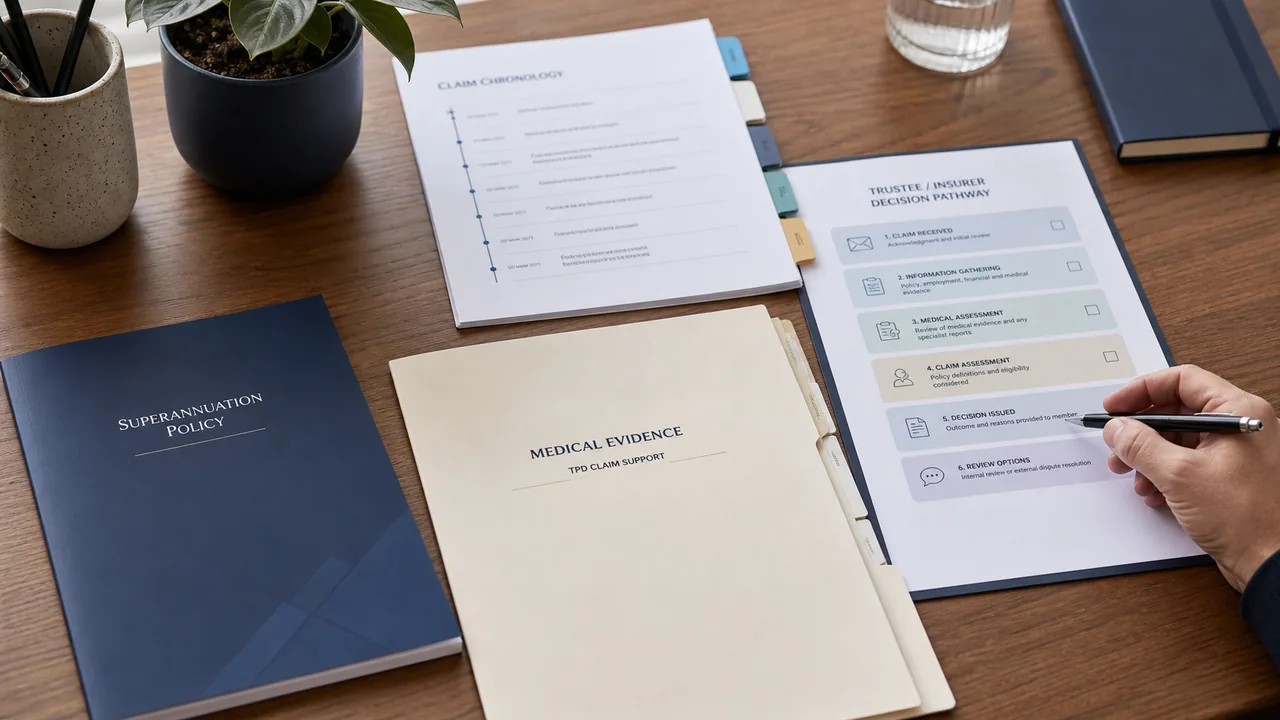
This triage map helps you decide what to check first in a TPD claim. The strongest starting point is usually the policy definition, followed by functional medical evidence, work-history detail, and timeline consistency across super, work, treatment, and related benefits.
The map does not predict the outcome; it helps you choose the next practical evidence task or guide page.
Claim file lens
Most TPD claim problems become clearer when the policy wording, medical proof, work reality and timeline are kept separate. Use this lens while reading so the page becomes a practical file checklist, not just background information.
Which TPD definition applies, and what must be proved under that wording?
Which diagnosis, treatment history, function limits and prognosis documents support the claim?
What does the evidence show about reliable, sustainable work capacity in real conditions?
Do the work, medical, insurer and superannuation records tell a consistent timeline?
Claim-file method
Our methodology is a practical file-review approach: test the claim file against policy wording, medical function, work history, chronology and decision pathway before treating the matter as ready to lodge or escalate.
Policy wording is the starting point: identify the exact TPD definition, cover period, waiting-period wording if relevant, and whether the test is tied to any occupation, own occupation, education, training or experience.
Medical function is the practical evidence question: separate diagnosis from function, then explain restrictions, treatment history, prognosis, failed recovery attempts, and why suitable work is not realistically sustainable.
Work history is the reality check: map the claimant's real duties, hours, physical or cognitive demands, modified duties, failed return-to-work attempts, and any gaps between job title and actual work.
Chronology consistency is the cross-check: super records, employment records, medical certificates, insurer requests, Centrelink or workers compensation records, and claim forms should tell one coherent sequence.
The decision pathway is often two-layered where cover is inside super: keep the insurer assessment and trustee/release-of-benefit decision distinct without overstating either.
This method is a practical review structure, not a promise of eligibility or outcome. It helps identify missing evidence, inconsistent dates, and weak explanations before those problems become delay or refusal points.
This guide is written for claimants, not as a copy of government material. These public sources help explain the superannuation, insurance, tax, and dispute framework that often sits behind Australian TPD claims.
If you are not looking for a general overview and instead need the page that best matches your immediate problem, use this quick routing guide:
This routing block is deliberately practical: it helps readers reach the right page faster and helps search and answer systems understand which subtopic should be cited for a specific TPD question.
This guide is designed for people who want a clear, non-hyped explanation before they commit time and energy to a claim. It is particularly useful if you are unsure about:
For detailed process steps, see TPD claim process. For evidence strategy, see evidence required for a TPD claim.
A TPD claim is an insurance claim. It is not automatically approved because a person has a diagnosis, has left work, or receives another type of benefit. The insurer/trustee assesses whether your circumstances satisfy the policy definition in force for your cover.
Many policies are linked to super funds, which can involve both insurer and trustee decision layers. The details differ between funds and policy periods. That is why claim preparation should focus on your specific policy wording rather than generic assumptions.
A claim may involve one or more of the following:
Most claim problems can be traced to one of three avoidable issues:
Good preparation means building a coherent record that answers the policy test directly and consistently.
Terminology varies. As general guidance only, claimants often encounter:
How these are drafted in your policy matters more than labels. To understand this distinction, see any occupation vs own occupation TPD.
Strong claims are usually document-driven. Useful evidence often includes:
Evidence quality is not about volume alone. It is about relevance and coherence against the policy test.
While every matter differs, many claims follow a pattern:
Process quality before lodging often determines whether assessment becomes smooth or drawn-out. See how long TPD claims can take and timeline stages and delay points.
People frequently assume their claim is not viable because they have one of the following. In many cases, these are risk areas to manage, not automatic disqualifiers:
The key is not to hide complexity. It is to explain context and build consistent evidence showing why temporary/assisted/limited activity did not amount to sustainable work capacity under the policy definition.
A careful pre-lodgement review can often prevent these issues.
You can also start with the TPD claim readiness checklist and then move to claim-specific advice.
A rejection is serious, but it is not always the end of the matter. The next step depends on the reasons provided, the evidence record, and whether the issues are legal, medical, vocational, or procedural. For practical guidance, see what happens if a TPD claim is rejected and how to appeal a denied TPD claim.
Many people underestimate the practical load of a TPD claim. The process can involve multiple rounds of document requests, follow-up with treating practitioners, and careful checking of wording across forms. Treating this as a project can reduce stress and improve quality:
A disciplined approach does not guarantee outcome, but it often improves assessment efficiency and reduces preventable credibility issues.
Insurers and trustees do not only read isolated documents; they assess the whole story. A stronger narrative usually has these characteristics:
When these elements are missing, even genuine claims can appear fragmented. When they are present and consistent, decision-makers can evaluate the case on its merits more effectively.
Many readers arrive on this page after searching for one specific scenario rather than for a general TPD overview. If that is you, it is usually better to move straight to the page that matches your facts and then come back to this overview with a clearer issue list.
This routing helps readers, search engines, and answer systems connect broad TPD questions with the most relevant next-step page instead of treating every case as the same.
Many claims do not fail at the first form; they weaken during follow-up. Additional information requests are usually a sign that the decision-maker thinks something important is still unclear. The safest response is usually to treat each request as a definition-and-evidence task rather than as a simple admin checklist.
If your claim is already in repeated follow-up cycles, it can help to review what evidence is needed for a TPD claim, independent medical exams in TPD claims, and what happens if a TPD claim is rejected so your next response is more targeted.
You do not need to solve the whole claim in the first month, but early organisation often prevents months of avoidable drift later. A practical first-30-days approach is to:
This kind of early file discipline helps readers, advisers, insurers, and trustees understand the same case history. It also makes later pages on TPD through superannuation, TPD claim process, and TPD claim readiness checklist more useful because you can apply them to a coherent record.
Readers who land on this page often move next to the question that best matches the pressure point in their own matter. If you are comparing options right now, these are the most common next-step paths:
Using the more specific page often improves both legal clarity and practical preparation, because it lets you focus on the actual dispute point instead of treating every TPD matter as interchangeable.
Sometimes yes. Short, modified, or unsuccessful work attempts may still be consistent with a TPD claim, depending on policy wording and evidence showing why duties were not sustainably maintained.
Not automatically. Parallel pathways can exist, but definitions and records must be managed carefully to reduce inconsistency and offset-related risk.
Evidence needs vary by case. What matters is credible, clinically supported information that explains functional limits and work capacity impact against policy requirements.
Timeframes vary with evidence complexity, policy structure, and responsiveness to information requests. Better pre-lodgement preparation often reduces avoidable delays.
No. Severity alone does not guarantee approval. Decisions depend on policy terms, evidence quality, and overall consistency.
If you want a practical view on eligibility, evidence gaps, or next steps, contact us. We can discuss your circumstances and explain a sensible pathway forward.
General information only. This page is not legal advice. Outcomes depend on policy terms, evidence, and individual circumstances.
Discovery gap to close
These linked scenario guides answer more specific claimant questions that Google may otherwise treat as low-priority long-tail pages unless they are surfaced clearly from a strong hub.